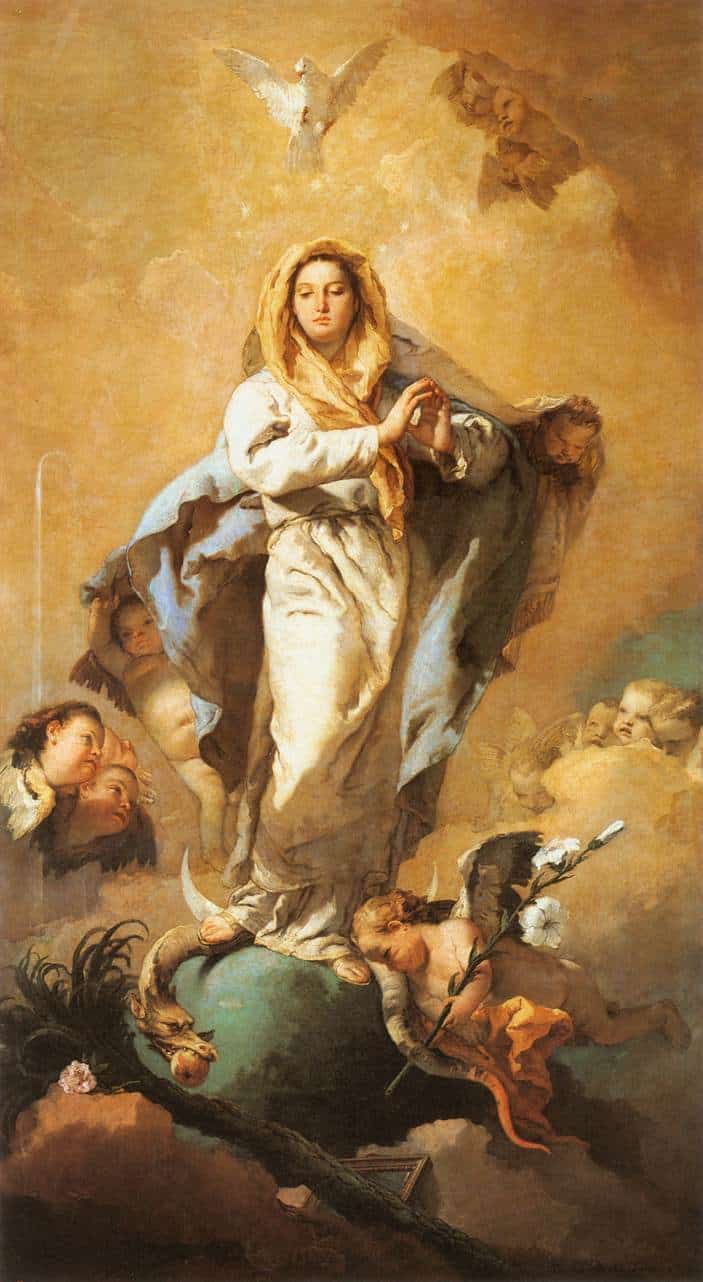
Protestant might say:
Why do you Catholics believe that Mary was without sin? It cannot be found in Scripture that she was without sin. It directly contradicts Romans 3:23.
The "all" in Romans 3:23 was translated from the Greek word pas. Like
the usage of the word "all" today, it does not necessarily mean each and every
person with no exceptions.
For instance:
• In the same letter to the Romans (11:26),
St. Paul says that "all Israel will be saved."
• In Matthew 2:3 it says "all
of Jerusalem" were troubled. Yet, were all of Israel going to be saved, or was
each and every person in Jerusalem troubled?
There are plenty of other examples
like these found all throughout the Bible. The main point is that the word "all"
had many different meanings in the Greek language, and that it does not rule out
the possibility of exceptions in Romans 3:23
____________________________________
The
fact remains that the words "Mary was without sin" are not found in the Bible.
Why do Catholics continue to believe in it?
True, the words "Mary
was without sin" cannot be found in the Bible. However, one will not find the
direct wording of "Mary was with sin" either.
As shown above, Catholics believe
that the Immaculate Conception has implied evidence for it within scripture. Add
this to the large amount of early Church writings on the topic, and it is no wonder
why Catholics continue to believe in it
Is the Immaculate Conception Biblical?
Yes, but only if you accept typology as a valid interpretation of
Scriptural texts (i.e. a method used by the Apostles and Fathers to
interpret Old Testament people, things, and events as types
foreshadowing New Covenant realities). Below are three common arguments
used by the early Church Fathers, the Popes, and the Catechism of the
Catholic Church to justify Mary’s title as the Panagia or “All-Holy.” The first is straight-forward, the latter two rely on typology.
Argument #1 Mary is Full of Grace
Luke 1:28: “And he came to her and said, ‘Hail, full of grace, the Lord is with you!’”
The term traditionally translated “full of grace” or “highly favored” is κεχαριτωμένη or kecharitomene. This perfect passive participle
form denotes something that happened in the past and continues into the
present. She was perfectly graced in the past and continues in that
state. Luke 1:28 has served as the locus classicus for the doctrine of the Immaculate Conception of Our Lady.
Argument #2 Mary as New Eve Having Enmity with Satan
Gen 3:15 “And I will put enmity between you and the
woman, and between your seed and her Seed; He shall crush your head, and
you shall strike at His heel.”
In this verse God addresses Satan. The Seed here is Christ. The Woman
is His Mother, that is, Mary. Thus Satan has perfect enmity with Christ
and with His Mother. The Catholic Church has interpreted this as
indicating the sinlessness of Christ and Mary. If either actually
committed sin, then they would not be at enmity with Satan but actually a
cooperator with Satan at times.
Argument #3 Mary as Ark of the Covenant
In the Old Covenant the Ark of the Covenant contained the Word of God
on stone. In the New Covenant, the Word made Flesh was also contained –
and that in the womb of the Blessed Virgin. The Catholic Church has
therefore understood Mary as the mystical Ark of the New Covenant. This
connection is made in the book of Revelation.
Rev 11:19-12:2 Then God’s temple in heaven was opened,
and the ark of his covenant was seen within his temple; and there were
flashes of lightning, voices, peals of thunder, an earthquake, and heavy
hail. And a great portent appeared in heaven, a woman clothed with the
sun, with the moon under her feet, and on her head a crown of twelve
stars; she was with child.
The Ark of the Covenant appears in Heaven and then in the next breath
(and next verse) St John describes a pregnant woman appearing in
Heaven. This Woman “contains” the Messiah.
The thinking goes that if Mary is the fulfillment of the Ark of the
Covenant, then she must be “all holy”. Remember that in the Old Covenant
a man was killed for touching the ark. It was holy. If the box that
held stone tablets was so restricted – so also would be the woman who
actually carried God Himself. And so she is all pure and all holy,
without the stain of sin.
More info @ Catholic Apologetics Notebook
The
Catechism of the Catholic Church beautifully states the doctrine of the
Immaculate Conception of Mary, that is, that Mary was herself conceived
without original sin:
491 Through the centuries the Church has become ever more
aware that Mary, “full of grace” through God, was redeemed from the
moment of her conception. That is what the dogma of the Immaculate
Conception confesses, as Pope Pius IX proclaimed in 1854:
The most Blessed Virgin Mary was, from the first moment of her
conception, by a singular grace and privilege of almighty God and by
virtue of the merits of Jesus Christ, Savior of the human race,
preserved immune from all stain of original sin.
 492 The “splendor of an entirely unique holiness” by which Mary is
“enriched from the first instant of her conception” comes wholly from
Christ: she is “redeemed, in a more exalted fashion, by reason of the
merits of her Son”. The Father blessed Mary more than any other created
person “in Christ with every spiritual blessing in the heavenly places”
and chose her “in Christ before the foundation of the world, to be holy
and blameless before him in love”.
492 The “splendor of an entirely unique holiness” by which Mary is
“enriched from the first instant of her conception” comes wholly from
Christ: she is “redeemed, in a more exalted fashion, by reason of the
merits of her Son”. The Father blessed Mary more than any other created
person “in Christ with every spiritual blessing in the heavenly places”
and chose her “in Christ before the foundation of the world, to be holy
and blameless before him in love”.
It is important to focus on the fact that Mary was redeemed and that she was “redeemed in a more exalted fashion, by reason of the merits of her Son.”
Rather than being redeemed later in life she was redeemed at the
moment in which she was conceived. There is one primary reason for why
Christ would save His mother in this way: Christ perfectly fulfilled the
Law and thereby fulfilled the commandment “Thou shalt honor thy father
and thy mother.” We know that Christ perfectly honored His Father. He
also perfectly honored His Mother. The most honorable thing He could do
for His mother was to redeem her “in a more exalted fashion” as the Holy
Father taught.
Source: http://taylormarshall.com/2013/12/3-easy-arguments-for-the-immaculate-conception-of-mary.html