Sunday, November 22, 2015

Thanksgiving 1, 2, 3, Squanto, Eucharista, Belloc

Most history books these days tell us that the first Thanksgiving was celebrated by the pilgrims in 1621. Not true. Perhaps these 3 facts will clear up this culturally accepted historical misconception which has reached the proportions of "myth."  
Have you ever heard the old adage, "real power belongs to those who write the history books?"  Unfortunately there is veracity in that statement, but we shouldn't let us deter us from seeking the truth.
But the truth is out there. Let's hang onto it. Here are the facts.

1st --> The First American Thanksgiving was celebrated on September 8, 1565 in St. Augustine, Florida. September 8 is the Feast of the birth of the Blessed Virgin. The Native Americans and Spanish settlers held a feast and the Holy Mass was offered. This was 56 years before the Puritan pilgrims of Massachusetts. 

2nd --> The next Thanksgiving celebration occurred on American soil on April 30, 1598 in Texas when Don Juan de Onate declared a day of Thanksgiving to be commemorated by the Holy Sacrifice of the Mass. Think about it . . . this was 23 years before the Pilgrims set sail from England on the Mayflower.
Don Juan de Oñate & the Mansos.
Painting by Jose Cisneros, courtesy of the University of Texas at El Paso 
3rd --> On the third Thanksgiving in 1621, the Pilgrims allegedly celebrated a happy meal with Native Americans and the rest is the history with which we are familiar.
Did you know that the Puritan pilgrims were violently anti-Catholic? The Puritans left England because they thought that the Church of England was too Catholic. These folks were strict Calvinists. The pilgrims also opposed celebrating Christmas, dancing, musical instruments in church, and even hymns. They considered these things too papistical.  Ironically, the Pilgrims shared the same problems that Catholics had in England. The Catholics who lived in Nottinghamshire where the Pilgrims originated, were persecuted mercilessly.


So while that 3rd Thanksgiving may celebrate the Calvinist Separatists who fled England,
there is more to the story. Catholics should remember that the same unjust laws that granted the crown of martyrdom to Thomas More, John Fisher, Edmund Campion, et al., are the same injustices that led the Pilgrims to Plymouth. Hmmmm, why don't the history books mention this? I do believe that the Protestant-shaded history textbooks is the fodder for a future post.

Here is my favorite favorite piece of Thanksgiving trivia.Remember Squanto, the beloved hero of Thanksgiving?  Squanto (also known as: Tisquantum) was the Native American man who mediated between the Puritan Pilgrims and the Native Americans. Squanto's history is amazing. He had actually been enslaved by the English but then freed by Spanish Franciscans. Squanto thus received baptism and became a Catholic. So it was a baptised Catholic Native American who orchestrated what has become known as the "first Thanksgiving."

Most importantly, let us remember that Thanksgiving" in Greek is Eucharista. Thus, the Body and Blood of Christ is the true "Thanksgiving Meal."

This Thanksgiving be sure to raise your wine glass and recite the wonderful limerick of Hilaire Belloc.
"Wherever the Catholic sun doth shine,
There's always laughter and good red wine.
At least I've always found it so.
Benedicamus Domino!"


Sources:
https://www.quora.com/What-is-the-difference-between-Puritans-and-Pilgrims
Taylor Marshall
http://www.texasbeyondhistory.net/paso/history.html

Friday, September 4, 2015

Template for an Apologetics Speech - Meaning & Significance Question

Every good speaker remembers to 1) Tell the audience what they are going to tell them.  2) Tell them.  3) Tell them what you just told them.
At the beginning add a hook,  introduce yourself, and let audience know what question you will be answering.
At the end recap, conclude, end decisively 
____________________________________________________________
INTRO – MANY TIMES YOU WILL WRITE THIS LAST
                  This is in place to "hook" the audience's interest
                  The hook might also be called an opener or teaser. It could be:
                  Scripture
                  Story or
                  Quote
DO NOT FINISH IT – LEAVE SOMETHING TO COME BACK TO AT THE END!

INTRODUCE YOURSELF & ANNOUNCE Q:
Hello, my name is ___________ and I would like to discuss the meaning and significance of __________________   OR
Hello, my name is ________________ and I have drawn the question, "What is the meaning and significance of __________________ ?" 

1) Tell the audience what they are going to tell them.
Give them a roadmap of where you are going together.
I will address this question through 3 points
Meaning
Significance
Application (with a Call to Action)

2) Tell them.
AND! Tell them where you are at each point. Keep that roadmap in front of them.
POINT 1) MEANING: define
________________ means / is defined as / _________________________.
      Quote your source if applicable

POINT 2) SIGNIFICANCE:
Why is this important?
You can elaborate to explain.
~What would happen if we did not believe or have this? Or, if this did not exist.
Who is “WE?” . . . . . . Believers / Christians / Catholics / a Nation / Brothers and Sisters in Christ / Children of God / a people /-- decide which and proceed accordingly. Make sure your audience knows (It is always helpful if you know your audience.)
Use Quotes, Scripture, Common Sense, etc.

POINT 3) APPLICATION (possible CALL TO ACTION):
What should I do with this? How does this apply to _______ (Us? You? Me?) Remember again to consider your audience -- and proceed accordingly.
What should we do? Is there a  “call to action”? If so, what it is it?
Because _____________________ we should ______________________.
Prepare to transition into tying this back to your INTRO

3) Tell them what you just told them.
4) RE-CAP and/or “In Conclusion” 
Let’s re-cap: 
We (have) looked at the meaning of ____________________
We (have) looked at its significance (____________________)
And we (have) looked at how this applies to us ( _________ ) 


FAST VERSION ~>  “To conclude let me (recap or) remind you that we have examined the meaning, significance, and application (with a call to action) of ________________________”     OR
In Conclusion, we have looked at ____________________________

TELL THE REST OF THE INTRO STORY HERE or @ very end 
In which way would it be more memorable/interesting/meaningful? 

END DECISIVELY WITH a Scripture or Quote (or repeat a major one / a powerful one / a completely logical one, etc.)
Or, GIVE THE REST OF THE INTRO STORY HERE (if not done in the re-cap)

Then say, “Thank you for your time and attention.” (or something close to that)


____________________________________________________________
  • Be sure to include appropriate Bible verses, and quotes. 
  • EMERGENCY EXIT PLAN  Have a practiced emergency conclusion in your arsenal. If you lose your way, go way off on a tangent, forget your planned ending, panic, or run waaaaay over time you will still end confidently. This might be a general quote, or a scripture tor just a rehearsed sentence or two to get you out gracefully.
____________________________________________________________

Here are some of the M/S choices that are included in the 100 questions:

What is the meaning and significance of the image of God?

What is the meaning and significance of original sin?

What is the meaning and significance of the virgin birth?

What is the meaning and significance of Original Sin?

What is the meaning and significance of the Incarnation?

What is the meaning and significance of Jesus as the Word of God?

What is the meaning and significance of Jesus as the Lamb of God?

What is the meaning and significance of Biblical canon?
____________________________________________________________

IN A NUTSHELL:

These are all above in RED 
1a) INTRO w/ hook
1b) Introduce self
1c) Announce the Q you will answer

2a) Meaning
2b) Significance
2c) Application/Call to Action

3a) ReCap and/or Conclusion (Finish story / Repeat / Reiterate)
3b) Make Sure You End Decisively 
3c) Say ,“Thank you”

Tuesday, June 23, 2015

5 Qs About Mary & A Wild Card Question

1) The Bible says "all have sinned." How can you believe that Mary was without sin? So, do Catholics believe that Mary did not need Jesus to be her Savior?

2) Why do Catholics believe Mary was so special . . . . she isn't even mentioned in the Old Testament. She is hardly mentioned in the New Testament.

3) The Bible says that Jesus had brothers and sisters. That proves Mary was not a perpetual virgin. Why do Catholics believe that? What's the big deal if she was or wasn't?

4) Why do Catholics worship Mary? For example, you say that prayer called, "Hail Mary." You have statues and pictures of her in your church and in your houses. You pray to her.

5) Why do you call Mary the New Eve and the Ark of the New Covenant?

WILD CARD: How can you prove the existence of God with this argument called "DESIGN"?


In addition to the CIA & SWAT websites, see also:
http://catholicbridge.com/catholic/martin_luther_on_mary.php

http://catholicbridge.com/catholic/mary_in_the_bible.php

http://www.catholicbridge.com/

Friday, June 19, 2015

Proving the Existence of God - Argument from DESIGN

Christopher Stefanick 


Catholic Religion Teacher Series:


The Argument from Design from Catholic Religion Teacher on Vimeo.


Terms to understand (in the context of our argument):
1) Theist: one who believes in God (as the creator of the universe)

2) Atheist: one who does not believe in God (as the creator of the universe)

3) Premise: the base of an argument (the concept or statement or proposition) from which another is inferred or follows as a conclusion

4) Evolution does NOT support atheism

5) Natural Selection - survival of the fittest

6) ANTHROPIC PRINCIPAL: the universe was specially designed from the beginning for human life to evolve (happen). . . . . specially designed for human life

7) PRINCIPLE OF CAUSALITY: can't get more in an effect than in sum total of all causes. Examples: 

  • 4+1+2=7 
  • Painting with red and blue gives you red, blue, and/or purple (you can't get yellow) 
If there is intelligence in effect (humans), there must be intelligence in the cause.

8) GOLDILOCKS PRINCIPLE: "just right" 
This is closely related to the ANTHROPIC PRINCIPLE

9) Teleological Argument: another term that means Argument from Design
The teleological or physico-theological argument, also known as the argument from design, or intelligent design argument is an argument for the existence of God or, more generally, for an intelligent creator "based on perceived evidence of deliberate design in the natural or physical world"

10) Syllogism: ˈsiləˌjizəm
  1. A form of reasoning in which a conclusion is drawn (whether validly or not) from two given or assumed propositions (premises), each of which shares a term with the conclusion, and shares a common or middle term not present in the conclusion (e.g., all dogs are animals; all animals have four legs; therefore all dogs have four legs ).
    • deductive reasoning as distinct from induction.
      "logic is rules or syllogism

    • OUR SYLLOGISM:
Premise 1: The more complex something is, the more likely it is a product of design (and not chance).

Premise 2: The universe (& many things within it) are infinitely more complex than all man made designs.

Conclusion: Therefore, the universe is a product of design (and not chance). The designer behind the universe is what we call God.


http://catholicreligionteacher.com/existence-of-god/ 
KEYNOTES (slides)  https://catholicreligionteacher.files.wordpress.com/2014/03/the-argument-from-design-keynote-pdf3.pdf

Mrs. Cortez' sources:
Taylor Marshall's Thomas Aquinas in 50 Pages
Kreeft's Arguments For God (specific)
Kreeft's Arguments For God  (broader)

Monday, June 23, 2014

The Immaculate Conception

Protestant might say:
Why do you Catholics believe that Mary was without sin? It cannot be found in Scripture that she was without sin. It directly contradicts Romans 3:23. 

The "all" in Romans 3:23 was translated from the Greek word pas. Like the usage of the word "all" today, it does not necessarily mean each and every person with no exceptions. 
For instance:
• In the same letter to the Romans (11:26), St. Paul says that "all Israel will be saved." 
• In Matthew 2:3 it says "all of Jerusalem" were troubled. Yet, were all of Israel going to be saved, or was each and every person in Jerusalem troubled? 

There are plenty of other examples like these found all throughout the Bible. The main point is that the word "all" had many different meanings in the Greek language, and that it does not rule out the possibility of exceptions in Romans 3:23

____________________________________
The fact remains that the words "Mary was without sin" are not found in the Bible. Why do Catholics continue to believe in it?
True, the words "Mary was without sin" cannot be found in the Bible. However, one will not find the direct wording of "Mary was with sin" either. 


As shown above, Catholics believe that the Immaculate Conception has implied evidence for it within scripture. Add this to the large amount of early Church writings on the topic, and it is no wonder why Catholics continue to believe in it


Is the Immaculate Conception Biblical?
Yes, but only if you accept typology as a valid interpretation of Scriptural texts (i.e. a method used by the Apostles and Fathers to interpret Old Testament people, things, and events as types foreshadowing New Covenant realities). Below are three common arguments used by the early Church Fathers, the Popes, and the Catechism of the Catholic Church to justify Mary’s title as the Panagia or “All-Holy.” The first is straight-forward, the latter two rely on typology.

Argument #1 Mary is Full of Grace


Luke 1:28: “And he came to her and said, ‘Hail, full of grace, the Lord is with you!’”
The term traditionally translated “full of grace” or “highly favored” is κεχαριτωμένη or kecharitomene. This perfect passive participle form denotes something that happened in the past and continues into the present. She was perfectly graced in the past and continues in that state. Luke 1:28 has served as the locus classicus for the doctrine of the Immaculate Conception of Our Lady.

Argument #2 Mary as New Eve Having Enmity with Satan


Gen 3:15 “And I will put enmity between you and the woman, and between your seed and her Seed; He shall crush your head, and you shall strike at His heel.”
In this verse God addresses Satan. The Seed here is Christ. The Woman is His Mother, that is, Mary. Thus Satan has perfect enmity with Christ and with His Mother. The Catholic Church has interpreted this as indicating the sinlessness of Christ and Mary. If either actually committed sin, then they would not be at enmity with Satan but actually a cooperator with Satan at times.

Argument #3 Mary as Ark of the Covenant

In the Old Covenant the Ark of the Covenant contained the Word of God on stone. In the New Covenant, the Word made Flesh was also contained – and that in the womb of the Blessed Virgin. The Catholic Church has therefore understood Mary as the mystical Ark of the New Covenant. This connection is made in the book of Revelation.

Rev 11:19-12:2 Then God’s temple in heaven was opened, and the ark of his covenant was seen within his temple; and there were flashes of lightning, voices, peals of thunder, an earthquake, and heavy hail. And a great portent appeared in heaven, a woman clothed with the sun, with the moon under her feet, and on her head a crown of twelve stars; she was with child.
The Ark of the Covenant appears in Heaven and then in the next breath (and next verse) St John describes a pregnant woman appearing in Heaven. This Woman “contains” the Messiah.
The thinking goes that if Mary is the fulfillment of the Ark of the Covenant, then she must be “all holy”. Remember that in the Old Covenant a man was killed for touching the ark. It was holy. If the box that held stone tablets was so restricted – so also would be the woman who actually carried God Himself. And so she is all pure and all holy, without the stain of sin.


More info @ Catholic Apologetics Notebook

The Catechism of the Catholic Church beautifully states the doctrine of the Immaculate Conception of Mary, that is, that Mary was herself conceived without original sin:

491 Through the centuries the Church has become ever more aware that Mary, “full of grace” through God, was redeemed from the moment of her conception. That is what the dogma of the Immaculate Conception confesses, as Pope Pius IX proclaimed in 1854:
The most Blessed Virgin Mary was, from the first moment of her conception, by a singular grace and privilege of almighty God and by virtue of the merits of Jesus Christ, Savior of the human race, preserved immune from all stain of original sin.
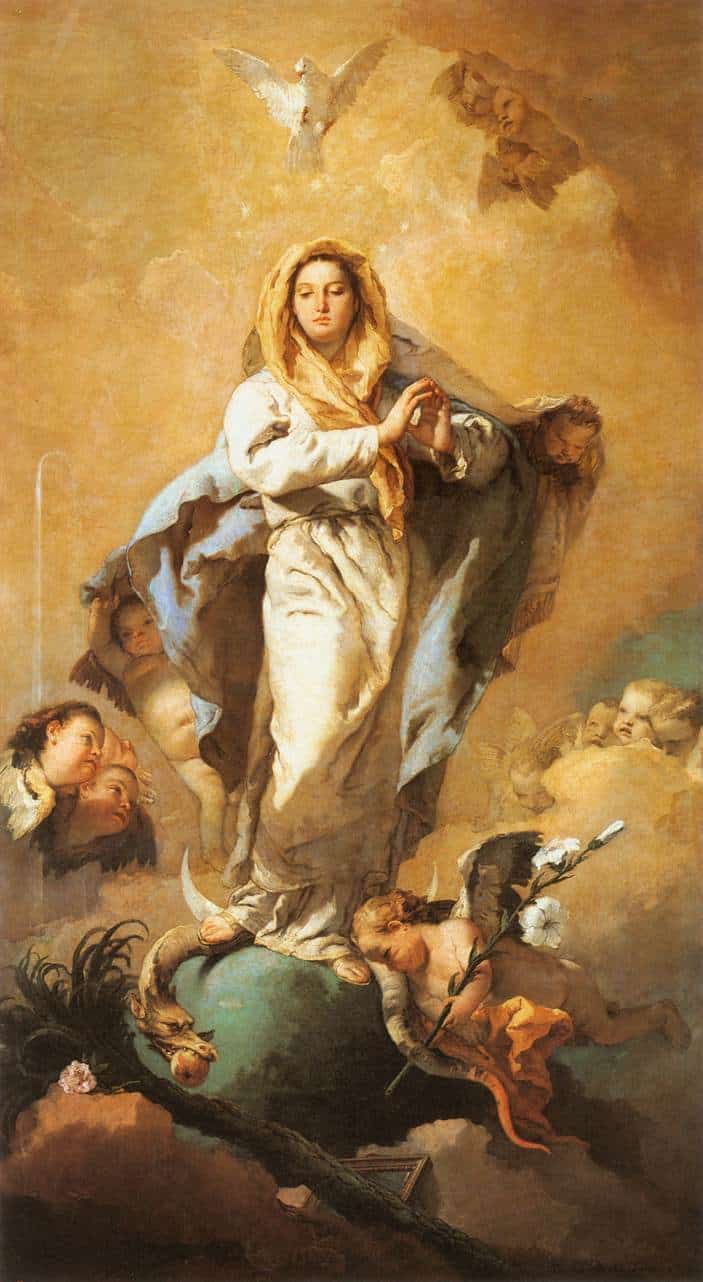
Immaculate Conception 492 The “splendor of an entirely unique holiness” by which Mary is “enriched from the first instant of her conception” comes wholly from Christ: she is “redeemed, in a more exalted fashion, by reason of the merits of her Son”. The Father blessed Mary more than any other created person “in Christ with every spiritual blessing in the heavenly places” and chose her “in Christ before the foundation of the world, to be holy and blameless before him in love”. 

It is important to focus on the fact that Mary was redeemed and that she was “redeemed in a more exalted fashion, by reason of the merits of her Son.” 

Rather than being redeemed later in life she was redeemed at the moment in which she was conceived. There is one primary reason for why Christ would save His mother in this way: Christ perfectly fulfilled the Law and thereby fulfilled the commandment “Thou shalt honor thy father and thy mother.” We know that Christ perfectly honored His Father. He also perfectly honored His Mother. The most honorable thing He could do for His mother was to redeem her “in a more exalted fashion” as the Holy Father taught.

Source: http://taylormarshall.com/2013/12/3-easy-arguments-for-the-immaculate-conception-of-mary.html

Tuesday, June 17, 2014

The Visitation (Edward Sri)

Our CIA boys have been studying the typology of Mary in the Old Testament. 
• We started our study with a close inspection of our much loved Hail Mary Prayer. 
• We read the the source of the prayer, which is Scripture, specifically Luke1:28, and 41-43. 
• We then entered into the deeper vocabulary waters of typology, foreshadowing, and pre-figuration. Our study of the three "types" of Mary in the OT has been approached with gusto and attentiveness. 
• Mary as the new Eve
• Mary as the Ark of the New Covenant
• The Queenship of Mary


The following notes are not proofed yet:
____________________________________________________
 Mary went in haste to serve Elizabeth - what a great model for us!

The way Elizabeth greets Mary is utterly remarkable!
She bestows titles upon Mary that have not been used for centuries in the Jewish tradition.

One title is: Blessed Art thou Among Women! 
There are only three women in all of Scripture who are called, "blessed among women."

Jael and Judith, who both cut off the heads of their enemies. And, Mary.
What does Mary have to do with these warrior Old Testament women?

These OT women cut off the head of their pagan enemy!

Harkens back to the first prophecy of the Bible, Genesis 3:15 (the Protoevangelium!)

The OT women were preliminary fulfillments of this prophesy.
Mary is the New Eve. The Ultimate Fulfillment of Genesis 3:15  is . . . The Blessed Virgin Mary! Because it is her son, Jesus Christ, who will defeat the devil.

____________________________________________________
Another title is: The Mother of my Lord
This shows us the Queenship of Mary.
Elizabeth refers to Mary as the Mother of My Lord.  Luke 1:43
God is "my Lord." 

"My Lord" is mother of the King, Mother of the Messiah; Mother of the Great Sons of David
 

Mary is being associated with that role of the Queen Mother because she is the mother of the new Davidic King, Jesus Christ. --- "The Mother of My Lord."


____________________________________________________
Another title is: The Ark of the Covenant which is great image in the Visitation scene.
This scene of The Visitation draws out those connection between the Ark of the Covenant of the Old Testament and Mary.


The Ark of the Covenant goes on a journey and stays in the house of Obed-edom for 3 months bringing great blessings upon that household.   
Mary goes on a journey. Mary journeys to the house of Zechariah for three month bringing great blessings upon that household.

David feels unworthy and says, "How can the Ark come unto me?"  
Elizabeth say, "How is it that the Mother of My Lord comes to me?"

Davis dances (leaping) before presence of the Ark of the Covenant.  2 Samuel 6
John the Baptist leaps in his mother Elizabet's  womb! Luke 1: 28

All of these things prophetically foreshadow Mary and the great journey she makes!


____________________________________________________
Elizabeth EXCLAIMS -- Luke chose this particular (Greek) word. It is used in the Septuagint (The Old Testament Greek translation) only 6X and each time it is used to describe the Ark of the Covenant  and -- people praising God before the Ark of the Covenant.
 
____________________________________________________
The Prayer of the Magnificat important!
Mary responds to Elizabeth by directing it all to God. 
____________________________________________________

source: http://www.spreecast.com/events/the-visitation-of-mary?referring_sid=146a7e615822b17ee3e:web.tab 

At the 45 minute mark, Dr. Sri has a WONDERFUL answer for those who ask us why we "worship" Mary. It is truly beautiful. 


Monday, June 2, 2014

3 Important Examples of Marian Typology

St. Augustine said that "the New Testament lies hidden in the Old and the Old is fulfilled in the New."

3 Important Terms to Understand: 
Typology  (detailed definition here)
Pre-figuration
Foreshadowing


Today we are studying the typology of Mary in the Old Testament so that we can defend our Blessed Mother. And, of course the typology, pre-figuration and foreshadowing of Christ is always right next to Mary.

Gotta love the way the Holy Spirit works! More young men have joined us. . . .Nick, Roman, and Jaden.

3 Important Examples of Marian Typology to Remember:


1) Mary is the New Eve    

and Jesus as the new Adam  -- Romans 5:14
Genesis 3:15 protoevangelium 

2) Mary is the New Ark of the Covenant  
 
•    Both (the Ark and Mary) were places of very important and sacred creations (the Covenant and Jesus).

The Ark contained 
• the  Ten Commandments (the words of God in stone),
•  a pot of manna, and
•  Aaron's rod that came back to life
[Deuteronomy 10:3-5; Hebrews 9:4].
The womb of the Virgin contained Jesus:
•  the living Word of God enfleshed,
• the living bread from heaven,
•  "the Branch" (Messianic title) who would die but come back to life [Luke 1:35].
 
•   The story of Uzzah and the Ark of the Covenant is found in 2 Samuel 6:1-7 and 1 Chronicles 13:9-12. As the ark was being transported, the oxen pulling the cart stumbled, and a Levite named Uzzah took hold of the ark. God's anger burned against Uzzah and He struck him down and he died
•   The Virgin Mary is the living shrine of the Word of God, the Ark of
the New and Eternal Covenant. In fact, St. Luke’s account of the Annunciation of the angel to Mary nicely incorporates the images of the tent of meeting with God in Sinai and of the temple of Zion. Just as the cloud covered the people of God marching in the desert (cf. Nm 10:34; Dt 33:12; Ps 91:4) and just as the same cloud, as a sign of the divine mystery present in the midst of Israel, hovered over the Ark of the Covenant (cf. Ex 40:35), so now the shadow of the Most High envelops and penetrates the tabernacle of the New Covenant that is the womb of Mary (cf. Lk 1:35).
SOURCE: Pontifical Council for the Pastoral Care of Migrants and Itinerant People, The Shrine: Memory, Presence and Prophecy of the Living God

3) Mary's Queenship is pre-figured in the Old Testament.
We will review and add this wonderful Queenship information at our next meeting

The Cookie Questions:
 
QUESTION 1:  
What is the
protoevangelium?  You must also be able to spell it correctly.
ANSWER:
It is the first prophesy in the Bible and it is a prophesy about Mary and Jesus.

QUESTION 2:
Where is it in the Bible?
ANSWER:
Gen 3:15

LAGNIAPPE:
Can you memorize it? Memorizing would be cupcake-worthy! I have included the DR and the NAB quotes - your choice.

Douay-RheimsGod is speaking to the serpent/snake . . . .
I will put enmities between thee and the woman, and thy seed and her seed: she shall crush thy head, and thou shalt lie in wait for her heel.


NAB:  God is speaking to the serpent/snake . . . .
I will put enmity between you and the woman, and between your offspring and hers;
They will strike at your head, while you strike at their heel.


In summary, Genesis 3:15 has a prophetic nature to it, for there is a promise in the future of redemption, that someone will crush the head of the serpent. God's judgement upon the serpent contains a promise of ultimate victory through the woman by her offspring. This concept will be developed in a spiritual sense throughout Scripture and the Fathers of the Church.  source: http://biblescripture.net/First.html

If you want to read more, more, more  about the
protoevangelium  . . . . try these sites:
http://www.vatican.va/holy_father/john_paul_ii/audiences/alpha/data/aud19861217en.html

http://www.amsterdamapparitions.com/the-woman-and-the-serpent-genesis-315/